Night dreams vs daydreams vs daily reflections: why tracking all three on one calendar reveals real patterns
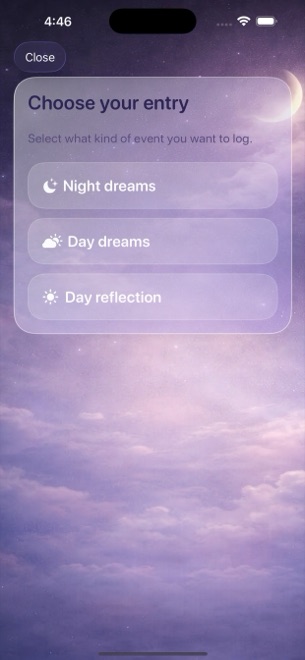
Most apps force you to split your inner life across three separate tools: a dream notebook for 7:00 AM, a scratchpad for 2:00 PM thoughts and an evening gratitude diary at 10:00 PM. Dreams Calendar gives Night Dreams, Day Dreams and Day Reflections dedicated wizards inside one local iPhone and iPad calendar — using the exact same 30 emotion chips so your nights and days finally speak the same language.
1. Side-by-side anatomy of the three entry wizards
Asking sleep-latency questions when you just want to jot down a sudden afternoon visualization creates instant friction, while leaving sleep metrics out of morning entries wastes valuable data. Tailoring each wizard to its moment of the day keeps every entry under two minutes.
In Dreams Calendar, every single step across all three wizards can be skipped and saved immediately, so busy days never turn logging into an all-or-nothing chore.
| Attribute | Night Dream | Day Dream | Day Reflection |
|---|---|---|---|
| When you typically log it | First 5 minutes after waking | Anytime a thought or image strikes | Evening wind-down before bed |
| Time representation on calendar | Violet block spanning real sleep start → end hours | Timestamped point entry during the day | Timestamped amber block on the day |
| Structured numeric scales | 1–10 quality, 1–10 morning energy, latency, awakenings, nightmares | None (keeps daytime capture fast) | None (focused on reflective prose) |
| Guided text prompts | Free-text dream diary | Free-text thought, visualization or idea | 5 questions: spent day, hard part, reaction, enjoyed, feel now |
| Shared emotion vocabulary | 30 positive & negative chips | Same 30 positive & negative chips | Same 30 positive & negative chips |
2. Spotting "day residue" across six calendar views
Sleep researchers use the term "day residue" for the way unfinished afternoon conversations, visual impressions and evening worries reappear remixed inside REM dreams hours later. When those records live in separate apps, the connection stays invisible.
Switching to Dreams Calendar’s Day or Multi-day timeline places yesterday’s afternoon Day Dream and evening Day Reflection right beside last night’s violet sleep block, while Month, Year and List views let you zoom out across weeks and seasons.
| View | What it shows across the 3 entry types | Best question it answers |
|---|---|---|
| Day & Multi-day timelines | Sleep blocks drawn across real hours + daytime timestamps | Did a rough afternoon precede a 3-awakening night? |
| Month & Year calendars | Logging density and consistency across weeks and months | Which weeks did I sleep short or skip winding down? |
| List view | Chronological stream of titles, notes & entry kinds | Where was that recurring dream or idea from last month? |
| Statistics (10 Swift Charts) | 5 sleep trends, 2 emotion rankings, 2 counts & 1 scatter plot | How does my sleep quality line up with emotion balance? |
3. Start with one entry type or combine all three at $0
You never have to log three times a day to get value. Many people start solely with morning Night Dreams via the single configurable daily reminder (8:30 AM default), adding evening Day Reflections only on eventful days.
Because everything stays locally in SwiftData on your device with zero subscriptions or in-app purchases, you can adapt your rhythm freely over months without hitting limits.
| Your primary goal | Suggested entry mix | Charts to watch after 3 weeks |
|---|---|---|
| Remembering more vivid dreams | Daily Night Dream + occasional Day Dream | Dream Logs per Week & Top Positive/Negative Emotions |
| Understanding light or fragmented sleep | Night Dream (sleep scales) + brief evening Day Reflection | Sleep Latency, Awakenings & Morning Energy |
| Reducing bedtime rumination | 5-question Day Reflection before lights out + Night Dream | Sleep Quality vs Emotion Balance scatter chart |
| Tracking recurring nightmares | Night Dream nightmare counter + Day Reflection ("What was hard?") | Nightmares per Day & Most Common Negative Emotions |
Do I have to log all three entry types every day for Statistics to work?
No. Charts plot whatever entries you choose to log — even if you only record morning Night Dreams.
How is a Day Dream different from a Day Reflection in Dreams Calendar?
A Day Dream captures a single wandering thought, visualization or idea in seconds, whereas a Day Reflection walks through five structured evening review questions.
Does Dreams Calendar mix these entries with my work appointments?
Never. Dreams Calendar does not read or touch your iOS system Calendar.
Are emotions from Day Dreams and Day Reflections counted with Night Dreams?
Yes — sharing the exact same 30 positive and negative chips lets Statistics measure overall emotional patterns consistently.